
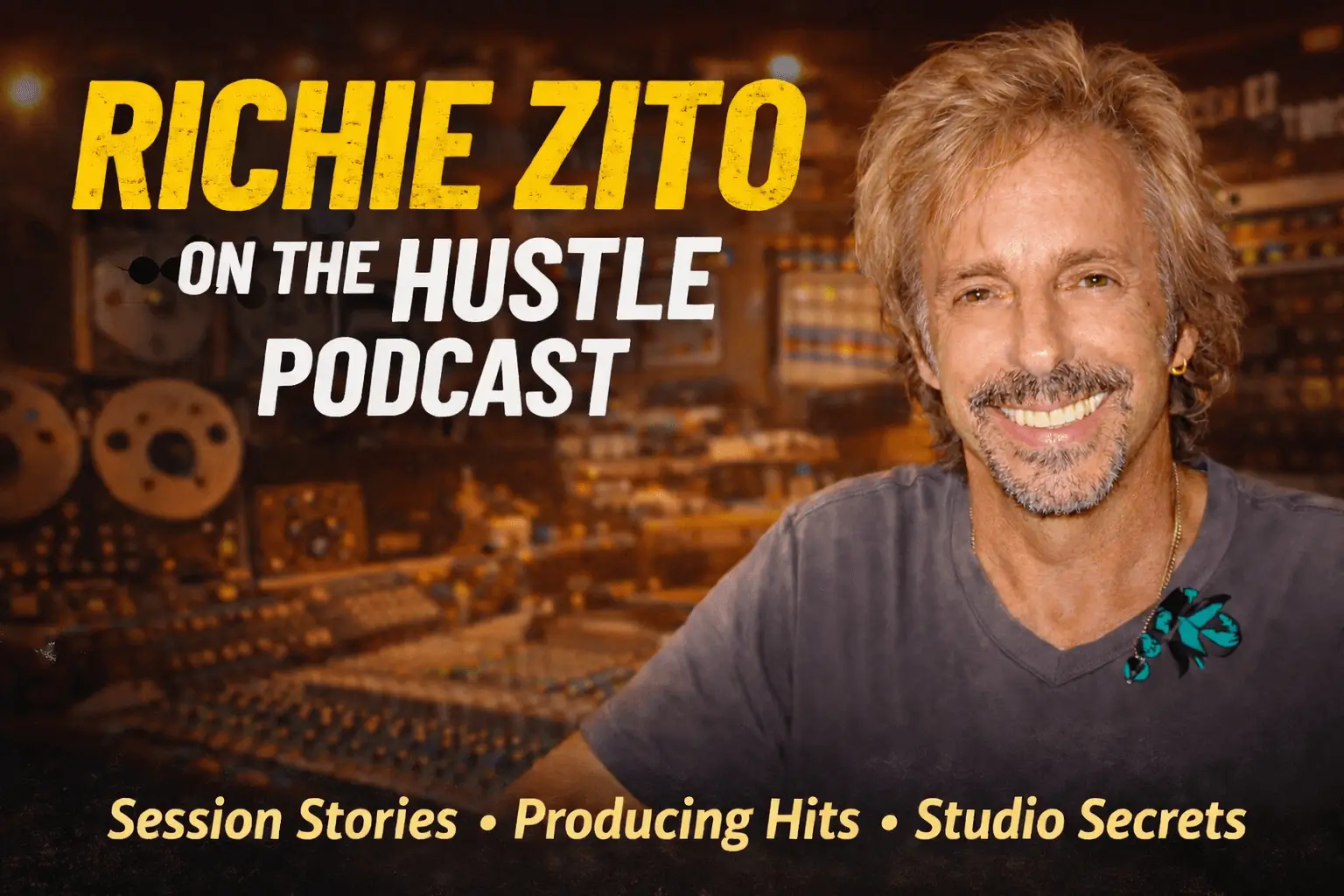
Richie Zito on The Hustle Podcast (Ep. 544): Epic Career Deep Dive with the Hit-Making Producer & Guitarist
Legendary ’80s producer and session guitarist Richie Zito joins host John Lamoureux on The Hustle Podcast (Episode 544, released October 15, 2025) for a wide-ranging 2-hour, 42-minute conversation covering his career as a guitarist, producer, and architect of the MTV-era rock sound.
Lamoureux introduces Richie as one of his favorite guests on the podcast, having started as an in-demand session guitarist who went on to become one of the biggest producers of the 80s and 90s (chosen as Billboard’s Producer of the Year in 1990).
Richie discusses touring with Neil Sedaka and life in the Elton John orbit, producing landmark recordings for Eddie Money, Heart, Cheap Trick, Poison, Bad English, and The Cult, plus his deep involvement in Giorgio Moroder’s soundtrack world, including Flashdance, Top Gun, Scarface, and Berlin.
The episode blends sharp humor with rare technical insight, including the real story behind “Take Me Home Tonight”, how “Danger Zone” came together, and reflections on how the music industry has changed since the peak of analog studio production.
Episode Breakdown
Obscure ’70s Sessions, Teen Idols & Wild Stories (00:05:00–00:14:06)
Richie opens with early professional work and industry absurdities, including touring with Sean Cassidy and comparisons with Leif Garrett. He recounts behind-the-scenes stories involving Barbie Benton, the Playboy Mansion, and the unexpectedly disciplined studio work behind Sam Kinison sessions.
Touring Years: Neil Sedaka & Helen Reddy (00:14:06–00:23:10)
The conversation shifts to life on the road, beginning with Richie’s extended touring work with Neil Sedaka and including a pivotal London performance tied to Helen Reddy. Richie describes major touring logistics and long-term proximity to the Elton John universe, with additional mentions including Robert Apere.
Production – Richie discusses his transition to music production, beginning with his work on Eddie Money’s album “Can’t Hold Back” in 1985 (00:23:11–00:39:51)
Richie breaks down the making of Eddie Money’s signature recordings, including the moment the episode lands on “Take Me Home Tonight”. He discusses the process of bringing in Ronnie Spector, demo selection, and the emotional background of “I Wanna Go Back”, which is credited to Billy Satellite.
Giorgio Moroder & the Soundtrack Years (00:39:52–01:37:47)
A long-form discussion of Richie’s collaboration with Giorgio Moroder, spanning film soundtracks and crossover pop productions. The era includes work on major cultural landmarks including Flashdance (with “What a Feeling”) and Scarface as well as high-profile work with Donna Summer and Barbra Streisand. Other mentions include Blondie and “Call Me”, plus musicians like Arthur Barrow and Paul Engemann.
During this era, Richie takes a key step in his career by earning a co-producer credit with Giorgio Moroder on “No More Words” by Berlin.
Cheap Trick – “The Flame” (01:25:16–01:44:23)
Jon tees up a dedicated section on Cheap Trick, focusing on how “The Flame” became their peak commercial moment and what it was like trying to align a power-ballad single with a band that had always been its own thing.
Peak ’80s Rock Productions: Heart, Poison, Bad English (01:44:23–02:07:59)
Richie reflects on producing and working with major rock acts at the height of MTV’s influence, including Heart with specific mentions of Ann Wilson and Nancy Wilson.
The conversation then pivots into Poison and the Native Tongue era, including the lineup shift to Richie Kotzen and how that changed the band’s sound, plus stories that specifically involve Bret Michaels.
Next up is Bad English, where Jon brings up friction around Jonathan Cain, and Richie explains the early-building phase around John Waite and how the project evolved.
The Cult – Ceremony Era (02:07:59–02:20:01)
Richie digs into The Cult and the challenges around the Ceremony period, including lineup changes, sonic expectations after Sonic Temple, and what he was trying to achieve with the band in a shifting early-’90s landscape.
Soundtrack Deep Dive: Top Gun & “Danger Zone” (02:20:01–02:30:33)
Richie returns to Top Gun and gives the clearest “how it was made” context for “Danger Zone”, including the process of getting it to Kenny Loggins and what Richie played on the track.
Career Reflections & Retirement (02:30:33–02:42:00)
In the closing stretch, Richie addresses retirement and the modern industry—anchored by the moment he says he’s “happily retired.” He also circles back to standout productions like Joe Cocker and “You Can Leave Your Hat On”, plus earlier marquee work like Cheap Trick and “The Flame.”
Full Transcript
Full Episode Transcript
Lightly edited for clarity and readability. Speaker labels added. Music clips noted. Timestamps are clickable via the site’s audio player and placed at major section starts plus key moments inside longer sections.
[00:00:00] Podcast Intro & Guest Overview
[Music]
John Lamoureux: Everybody, welcome back to The Hustle, it’s John Lamoureux.
Okay, our guest this week is big time producer, Richie Zito.
Now, Richie checks a lot of boxes in terms of best or favorite guests we have on the podcast because he starts out as a very in demand session guitarist. We love having session guys on here cuz they’re full of great stories.
Eventually in the early 80s, he transitions into production, and he becomes one of the biggest producers ever, or at least of that decade.
I always think of him when I think of this song, and Eddie Money. Take me home tonight, he was the producer of this.
In addition, he produces people like Bad English, and The Cult, and Poison, and Charlie Sexton, and we talk about all of these. There’s Cheap Trick, he does The Flame. Anyway, tons of big stuff in the 80s.
But before that, in the session world, he worked really closely with Giorgio Moroder for a long time. He was kind of in that stable. You might remember when we’ve had previous guests like Paul Engemann and Arthur Barrow, other people who were in the stable of Giorgio’s.
So he’s working on all of the Giorgio songs from that era, like Danger Zone. And he’s working with him on Berlin albums and Phil Oakey albums and stuff like that.
But the session work goes back to, I mean, I love stuff like this. There’s Neil Sedaka and Helen Reddy, and he plays for a while with Elton John. And there’s Heart appears in here, and Sam Kinison appears in here. Anyway, tons of fun stuff to talk about from Richie Zito.
I’ve been wanting to make this happen for a long time. I’m trying to find him for years. Special thanks to a certain someone who helped put me in touch with Richie. Thank you, you know who you are.
But anyway, I’ve been wanting to do this for years because he’s just done so much fun work that I thought would be interesting to talk about. And sure enough, it was. He’s basically retired now, but he called me from home in LA.
Let me give you guys a heads up. So many musical references come fast and furious in here that we didn’t insert every single one like we normally do. Because it just would have kind of bogged down the flow. And if it was a song that everybody knows already, unless he’s talking about it specifically, we kind of leave some of those out. Because you already know what he’s talking about. I don’t need to play the snippets to remind you, right? So anyway, that’s what’s going on. Here’s Richie.
[00:05:00] Obscure ’70s Sessions: Teen Idols, Barbi Benton & Sam Kinison
John: Okay, when I have someone who’s a session guy or a producer, and in your case, it’s both, on the show I sometimes like to start with something really obscure they did, really obscure that maybe I just like or I find interesting. You played on albums by both Leif Garrett and Sean Cassidy. And I’m curious of the two of them, who was more invested in the process?
Richie: I remember, I knew Sean better.
John: Okay.
Richie: I remember playing on more songs for whatever reason. And I actually did some shows with him. Yeah, there was a handful of shows, me, Carlos Vega, rest in peace. I don’t know if you know who Carlos was.
John: I do, sure.
Richie: I’m trying to remember who else was in the band. And we did a handful of shows one summer. So I got to know him a little better. But I didn’t play on any of Sean’s hits. I played on Eric Carmen’s version of Hey Deanie, which I think was a hit. Which I think he cut and had a big hit with. But I did play on I Was Made for Dancing.
John: You did? You’re on that?
Richie: Yeah, that’s—
John: That’s great.
[Music clip: “I Was Made for Dancin’” – Leif Garrett]
Richie: Yeah, I play for dancing on, on, on, on our love. Yeah, I play for dancing on, on, on, on our love.
[Music continues]
Richie: And I have a friend that does, that writes and directs movies. And he invited me to a premiere of one of his movies. It was, I think it was called, I think it might have been a Netflix film. It was called My Dinner with Hervé. It was a story of Hervé Villechaize.
John: Yes, I remember this Peter Dinklage.
Richie: Yes, exactly, exactly. So I went to the premiere or a screening, whatever it was. And I heard, so I went up to my, and they used that song. I went up to my friend after I said, yeah, I’m in your movies. What do you mean? I said, I played on I Was Made for Dancing.
John: [Laugh] So.
John: That’s great. Now similarly, you played with Barbi Benton.
Richie: I did, yeah.
John: She was a Playboy model. She was Hugh Hefner’s girlfriend. What was it like playing with Barbi?
Richie: I was just in the studio, my good friend at the time, Robert Apere. Who produced Neil Sedaka, who I met Robert through another friend, playing on some demos for one of my friends, Robert was developing him. And Robert and I kind of became pals, music buddies. He took a liking to my playing. And I can segue into the story of how I got involved with Neil Sedaka. In fact, I’ll go right back to, I’ll go back to Barbi.
John: Okay.
Richie: So I was just called to play on one of her records. Robert Apere, she was on Playboy Records. Everybody was invited up to the Playboy Mansion to take photos. But I wasn’t invited cuz I mean, I was invited but I couldn’t go cuz I was on the road with Neil Sedaka. And my favorite Barbi Benton story is, I knew her a little bit. Not best pals, but I got to know her a little bit. And I was a guitar player, I think his name was Dan. I don’t wanna misquote, say who it was cuz I’m not sure.
John: Okay.
Richie: But he was doing a TV session for a variety show back then. We’re talking about the 70s.
John: Sure.
Richie: And I think it was because his wife was giving birth. He asked me to sub for him. In fact, I’m pretty sure it was Dan Ferguson was his name. And I subbed for him. And I didn’t do a lot of those sort of sessions, but whatever it was, it was. And Barbi was one of the guests on the show with some variety show. I don’t know who’s—
John: Uh-huh.
Richie: And I was in a room full of an orchestra of LA session people, string players, horn players and everything. An older crowd, and at the time I was in my 20s. And Barbi recognized me and came over, Richie, how are you? And then everybody looked at me like—
John: Yeah, how do you know the playmate?
Richie: Well, yeah, cuz I wasn’t a regular of that sort of, I wasn’t first call for that sort of thing.
John: Right.
Richie: But yeah, she was quite nice.
John: I don’t know how, I mean, I only listen to one or two to get ready to talk to you. And they’re really pleasant country albums. They’re not that bad.
Richie: Yeah, it’s been a while, we’re talking, that’s like mid 70s.
John: Yeah, I know, I’m throwing out weird stuff from way back. Now, let’s finish off this celebrity kick here with Sam Kinison. So you produce Wild Thing, I believe.
Richie: I did, I did.
[Music clip: “Wild Thing” – Sam Kinison]
John: My question is just basically how much cocaine is on hand at a Sam Kinison recording session?
Richie: God, I don’t, that’s those kinds of questions.
John: [Laugh] I know, sorry.
Richie: But that’s what you imagine, you know what I mean? That’s what you imagine. It was fun because it was like I went to the video shoot after we did this.
John: You did, okay, that thing was classic.
Richie: And it was classic, but the session was good too. I think it was Mike Baird on drums, and pretty sure Rudy Sarzo played bass. I don’t think CC Deville played, but I did some recording with Sam later that CC was involved in. Pretty sure it was Phil Collen from Def Leppard.
John: Sure, okay.
Richie: And there’s a second guitar player, maybe it was CC, I really don’t remember. And it was fun, we cut it quick. I knew the song since we used to play it in cover bands when I was 13, 15. And then I went to the video session and it was sensational. And literally every rock star that you could name that was available.
John: I remember it well.
Richie: Which is pretty well every rock star of the 80s.
John: Yes, I mean, I jokingly mentioned cocaine. But I am curious if it is a party environment, because it’s Sam and he’s a comedian, he has famous friends. So it’s always funny, always on, or is it a semi-professional recording music environment?
Richie: No, it was very professional, it was very important that we cut the track. And don’t forget, even though Sam more than pulled it off, it was sort of our turf, not his, cuz it was a recording session for music. So he was, I wouldn’t say off balance, by no means.
John: Yeah.
Richie: And he traveled with sort of a troupe of comedians that actually opened his show at the time when he was touring, cuz he was pretty big at the time, rest in peace. So it wasn’t party time, it was make music time.
John: That’s great.
Richie: But I remember at the time, I wasn’t really that familiar with him. I know he was like the scream, no, I’m trying to remember if I’d already seen Back to School or not, which was classic as hell.
John: Absolutely, I still love that movie.
Richie: Yeah, me too, and him in it is fantastic, he’s a little scene. But maybe I’d already seen that, and—
John: Okay.
Richie: But I remember it was an early morning, it was on a comedy album, that song. It might have been pretty successful, too, and it was the only musical thing. So they sent me a test pressing or something to approve of the song. And the album, and unfamiliar with his stand up, I was like, never forget, it was earlier in the morning. And I was in a bathrobe, and I was sitting, sit down, put the test pressing on to check. I’m sure there was no glitches or whatever. And I couldn’t believe how funny it was. I was almost only peeing myself. I think his bit about having sex with it, being the cadaver in the morning. And someone was violating him and yeah, so.
John: He was a force.
Richie: He was a force, him I got to know a little better. I did go to some parties at his house, he definitely had some celeb friends.
John: I bet he did.
Richie: But yeah, it was a bit, yeah, it was a bit.
John: Okay, yeah, this is the 80s we’re talking about. That’s kind of just what I imagine the 80s being.
[00:14:06] Touring Years: Helen Reddy, Neil Sedaka & the Comeback
John: Now I wanted to push back, not push back, but I wanted to focus on something you said about going out live playing with Neil Sedaka. You’re on a Helen Reddy live in London album as well.
Richie: Yeah.
John: Now I’ve had, as I said, several session guys on here, tons of them over the years. And my understanding is that a lot of them don’t go on the road, because they miss out on the play rates that they can make just staying in the studio in LA. And like the Toto guys, that was always a big thing. Like are we gonna stop our session career so that we can put out our own music and pause this kind of gravy train we’re on? So you did go out and tour, was that a difficult decision to make?
Richie: Well, two different things. One is Helen Reddy was just a one time thing.
John: Okay, I didn’t know if you went on a long tour with Helen Reddy or something like that, it was one show.
Richie: No, no, one show, first time ever.
[Music clip]
Richie: We flew, we went to London, and I don’t think, maybe we rehearsed, I don’t know. And I think I knew our musical director, and he asked me to do it. I don’t remember exactly, but they asked me to do it, and I said, sure, why not? And we flew to London, did the show. We’re a tuxedo, we’re a tuxedo, we’re a tuxedo. Went to a club after, had a party, Jeff Wald was her husband/manager at the time. And he took over an area of the club for us and had a great time and flew home. That was my involvement there. I think I worked on some of her music later but I don’t know if you know my credits, I think I might have.
John: I was looking at him, that was the one that jumped out to me because of the live aspect, which again is a very strong business decision for session guys.
Richie: Well, yeah, at the top—
John: But if it’s one day, that’s nothing.
Richie: Well, I mean, literally, I can’t remember staying in the hotel. I didn’t even stay, I don’t think I stayed an extra day.
John: Okay.
Richie: But now with Sedaka, that’s different.
John: Yeah, tell me about Neil.
Richie: Well, my dream was to go into the studio, you know what I mean? I wasn’t successful. I mean, I had moved to LA like in 1973 when I was 20. And that was, I think, late ’74. And like I said, my friend Robert Apere, who produced that Neil Sedaka album, which begat Neil’s comeback, which we can talk more about. But, so I was working on some demos for a buddy. And Robert was producing his demos and developing this guy, talented guy. And Sedaka, they had already recorded Laughter in the Rain. Laughter in the Rain was the song, I mean, this is so many years ago. I don’t know what the age group listens to your podcasts or—
John: A little bit of everybody.
Richie: Yeah, so, but Laughter in the Rain was a big song.
John: It was.
Richie: But it wasn’t a hit yet. It was climbing the charts, and Neil had to do a midnight special. And Robert just called the session players. And Dean Parks, who played on the record, wasn’t available.
John: He’s been on here, so Dean’s been on here. So I didn’t realize you replaced him cuz he wasn’t available.
Richie: Yeah, I wouldn’t say I replaced him, but he certainly was the first phone call.
John: Yeah, yeah, yeah, yeah.
Richie: But so he called, I guess I’ve seen that clip over the years on YouTube, and it was Russ Kunkel on drums. It was David Hungate on bass. David Foster, who I don’t know if you see, but he was on keyboards. On that particular show, I was the only guitar player. I don’t remember, yeah, Brian, maybe Brian and Brenda Russell, same background. Brenda became very famous after that.
John: Yep, yep.
Richie: And I got that phone call.
John: That’s right.
Richie:</strong> And so I got to meet Neil, cuz we did rehearse in the studio once, did the show. And his comeback had sort of started in England. That was a very, very important part of my career.&amp;lt;/strong></p>
John: Tell us.&amp;amp;lt;/p>
<strong>Richie: Just don’t
forget, he was part of the Elto
n John universe.</p>
John:&amp;lt;/strong> Absolutely.</p></p><</p>
/p></p>
Richie: Also was important to my career. So he had an upcoming tour in England. And I guess he needed a guitar player. He had a bass player and a drummer. The drummer was a guy named Andrew Steele, who was in a band called The Herd with Peter Frampton. Gary Taylor back a million years ago, and a bass player with David Winter. And I can’t remember, I don’t know who I replaced. It was either a guy named Big Jim Sullivan, who was Tom Jones’s guy, who was on Tom’s TV show when I was a kid, so I still didn’t know that, sorta. And after that was Andy Summers.
John: Yeah, really?
Richie: Yeah, so—
John: Andy was involved, wow.
Richie: So I think I might have replaced Andy Summers.
John: Crazy.
Richie: And they used to joke because the bass player’s name was Winter and Andy was Summers.
John: [Laugh]
Richie: And I mean, I’m a big fan of his. I wasn’t at the time, it was long before the Police. This was 1974, 75. And I read somewhere, Andy had said some really nice things like that. That came along at a time in his life where not that economically, necessarily. There was something about it that he really liked. It meant a lot to him having that relationship and that situation. So when Neil asked me to go, we did a variety of sort of a combination of playing it like one of the halls. I forgot, Avery Fisher Halls in New York. The one in London, I don’t know the name of it. One like an opera hall, whatever those things.
John: Albert Hall?
Richie: Yeah, maybe Royal Albert Hall. Yeah, maybe that, that was probably it. And then we did some working man’s clubs in the north of England. I was there for ten weeks.
John: Wow.
Richie: I had toured a little bit with Bobby Hatfield, but that was a very short period of time. And as we were touring, that record was climbing the charts in America. Cuz that album was a combination of some songs he had done with some of the guys from 10CC, I think probably—
John: I just saw 10CC in concert last night.
Richie: I heard, yeah, was it good?
John: It was, I’m not a super duper fan or anything. But Graham was on here a couple of years ago, and so they put me on the list. Bless him, and they put on a really great show. It was fun.
Richie: Two of them produced some stuff with Neil on that album. And then the rest of the album was produced in LA with Robert Apere, before I was called by anybody to do any kind of session work. And so we did that, and then the record started to climb the charts more. And then we went back to the States, so he was then asked to tour the States. And so we toured the States mostly, I think it was mostly clubs at first. But then it blew up kind of quick. The song went to number one, I’m pretty sure. And then within months, Captain and Tenille covered a song from that album called Love Will Keep Us Together.
John: Yep.
Richie: Which was also number one on Grammys. They gave him a shout-out in the tag of the song Sedaka is Back, which was the name of his album.
John: Yeah.
Richie: And then his next single was a duet with Elton called Bad Blood. So Elton, so Neil, it was a comeback, it was a full-on comeback. And all of a sudden, it was Learjets and limousines. And I did it for almost two years.
John: My gosh, that’s wild.
Richie: So at that point, no, there was nothing to give up.
John: Sure, makes sense.
Richie: Absolutely nothing to give up, everything to gain, and I had a blast. I had a really good time.
John: I’m gonna put a pin in the rest of the Elton stuff, cuz I got several questions that relate to that that I’ll ask about later.
[00:30:30] Eddie Money Era – “Take Me Home Tonight”
John: Now, when I think of you and your production work specifically, the main album that comes to my mind is Eddie Money. In fact, I can’t hold back, I’m looking at it right here. And you’re playing guitar and/or synthesizers on pretty much every song on the album. My main question to you is about Be My Baby, Take Me Home Tonight. When the album, are you, as the producer, the person conceiving that song? Because it was pretty high concept to mix Eddie Money with Ronnie Spector. She’s gonna come in and sing this part that calls out to her biggest hit. Without her being there, that song doesn’t really make a lot of sense. And so, who wrote it, who conceived of it, who got all the parties together? How did this work?
Richie: That was a time in the record making process, and a lot of artists who’d had success were starting to employ outside songs and outside collaborations. Many, many, i.e. Aerosmith is a great example, and had a lot of success with it. So, you gotta put yourself in that at that time. That was the time. And Eddie, like most artists, was used to having success with songs he co-wrote. So, not having to, but taking advantage of the opportunity of that sort of, of cutting a song by someone like a Diane Warren or a collaboration. But still, it was new to him. It was not the best news to him. And Eddie and I became really, really close friends. I miss him all the time. I think of him constantly. I speak, I’m in pretty good touch, close touch with his widow. So, we became friends, but we’re both very strong personalities. We started off butting heads. I think our first meeting was argumentative, and I think that was one of the reasons his manager thought it was a good idea to trust me. They kind of sensed I wasn’t afraid to argue with him.
John: Yeah, you were going to stand up to him?
Richie: Yeah, so anyway, that’s the backstory. Then, so I was up in the San Francisco area, which is where Eddie lived at the time, and we were doing some demos in the recording studio. Because that’s the difference. If you’re sitting around with a band and everything is written by, internally by the band, you work it out with the band. Sometimes you don’t know if a song’s going to fit. You’re working from a demo nine times out of ten. In fact, demos, I’m going to digress just a little bit. One of the things we did to make a living as guitar players and musicians, when we weren’t quite up to that being called for record dates, I used to play on demos. Because singers, songwriters had to go out and have their publisher pay for a demo, pay for a studio, pay for musicians, record it. I played on the demo of “Hit Me With Your Best Shot.”
John: Really?
Richie: Yeah, me and turned out Dean Murray from Elton’s band also. Swear to God. This is a very musical time in this town. Everybody was everywhere. Another guy I miss. Anyway, so we were in the Bay Area. We were doing some demos of some potential contenders, and we got to this song, “Take Me Home Tonight.” It was written by a pair of English songwriters. You’re going to have to check. It’s written by Mike Leeson and Peter Vale. Yeah, because I did another song with Cheap Trick. And I think that was also English songwriters. But “Leeson and Vale,” right. They wrote the song, we got it. And it came to the time, it was written. I mean, the part was written in, just like Ronnie sang, “Be My Little Baby.” But it was sung by, I think it was a male, the whole song. And we got to that part, and Eddie basically said, “Fuck you. I’m not singing ‘Be My Little Baby.'” So he got it. There was a girl at the studio who happened to be a singer. Don’t remember her name. And we asked her to sing it, and she sang it. And then it became screamingly obvious. Screamingly obvious that the song, because Eddie had sung the demo. A demo, our demo. And it became screamingly obvious that the only person on the planet that could sing her part was Ronnie Spector. And then, so we cut the track. So somebody knows. Somebody knows and has to get Ronnie. There you go. So, you know, as happens, management talks to management, and there was a glitch. Whatever Ronnie wanted didn’t make sense to Eddie’s management. And she was off the table. And Eddie and I were together at this point making a record. So we looked at each other like, “Fuck this. This can’t, fuck that.” So I made a phone call. So we talked, you know, Eddie and I. And I went around everybody, and with Eddie, I’m going to just say together, only I picked up the phone, and called Ronnie’s manager, who was her husband, and said, “Listen, we got to make this happen.” And then at that point, it became clear that she really wanted to do it. Really? Okay. It was just, you know, whatever terms. So we talked to her. Eddie called his management and said, “Make this fucking deal.” And they made the deal. And Eddie, and then Eddie arranged. He sent a limo and flowers to pick her up, you know, when she arrived. And she came, and the rest is history. So that song was on a pile of songs that somebody, anyone else could have picked from the pile that Eddie was the guy who got there first, or got there best, or whatever, and had the grandest idea for the song. I mean, back then, like I said, there was a lot of people cutting songs. I guess it’s probably, I don’t know if it still is in Nashville, but it continued way beyond Los Angeles, you know, another least decade or two, or maybe even currently in Nashville, where publishers are having meetings with producers and A&R people and saying, “Here’s songs, here’s songs. You’re looking for songs for this song, for that one, for this song.” And that song came out, came along.
John: So my favorite song on that album has become “I Wanna Go Back.”
[Music clip: “I Wanna Go Back” – Eddie Money]
John: And the older I get, the more bittersweet that song becomes. I feel it stronger every passing year of my life, you know? And it was originally by a band called Billy Satellite, and sounds very different than the version Eddie did. And I would even argue that their version doesn’t even come with that same bittersweet nostalgia to it that yours does. And I wondered if that song was also a part of this pile of songs that were being like, “Who wants to try this one? Should we try ‘I Wanna Go Back’ and see what happens?”
Richie: The Bay Area, you know, I’m very much at the time especially, very much, you know, rooted in LA. The Bay Area music scene is much smaller, and was much smaller. And a friend of mine, whose brother, a guy named Marty Cohn is no longer with us, was an A&R rep at Warner Brothers. And I met Marty down here, and he lived down here. And Marty’s brother, Bruce Cohn, managed the Doobie Brothers, right? So there’s a lot of the Bay Area, and Eddie was managed by Bill Graham, who basically ran San Francisco concert business, at least. So everybody, it’s a small crowd, and Billy Satellite, Monte, yeah, and then he had a record, he did a record in Nashville, kind of a big push on it a number of years later. But Monte was the lead singer of Billy Satellite. The song was also, before we got to it, it was cut by Greg Phillinganes, did a version.
John: Really? I gotta find that.
Richie: Yeah, I don’t know if it ever came out. It must have come out, or I wouldn’t know about it. I mean, a lot of people thought that thing was a hit.
[00:53:19] Giorgio Moroder, Soundtracks & Early Production
John: [Discussion of first Billy Idol sessions, Keith Forsey producing Charlie Sexton (“Beat’s So Lonely”), “The Heat Is On” for Beverly Hills Cop, Nina Hagen, etc.]
Richie: I played guitar on the first Billy Idol sessions… Keith Forsey produced Charlie Sexton… I played on “The Heat Is On”… Nina Hagen…
John: Did you have something to do with the first Charlie Sexton album?
Richie: I played guitar, I’m probably on Beat So Lonely.
John: Okay, I like that album a lot.
[Music clip: “Beat’s So Lonely” – Charlie Sexton]
John: The thing I’ve always found interesting about Charlie is that I remember when he came out, Gunsblazing as a guitar phenomenon… That album features very little actual guitar mastery. It sounds more like it was made by machines and robots…
Richie: Well, I mean, Keith Forsey produced it… All the Billy Idol stuff is all drum machines… Keith is a drummer and Keith is a drum programmer… Charlie’s record was probably made very much like that.
John: We didn’t talk about Top Gun, which I had a lot to do with.
Richie: There are guitars on “Take My Breath Away”… I programmed the drums… I played everything on “Danger Zone,” literally.
John: You did?
Richie: Yes… Paul Engemann sang the demo… By the time it came time to do the demo for Kenny… I couldn’t get anybody to record the song with me… So I went in the studio, just me and Arthur Barrow… I programmed the drums, played the bass, DX7 parts, guitar… 99% me… That’s the track Kenny did.
John: My gosh. Wow.
Richie: “You Can Leave Your Hat On” from 9½ Weeks… One of my favorite records… Came from a conversation with director Adrian Lyne… Added the horn section inspired by Mad Dogs & Englishmen.
[Music clip: “You Can Leave Your Hat On” – Joe Cocker]
[01:25:16] Peak ’80s Rock Productions: Cheap Trick, Heart, Poison, Bad English, The Cult
Full discussion of producing Cheap Trick’s “The Flame” (#1 hit and comeback), Heart albums, Poison hits, Bad English, The Cult’s Ceremony (compared to Sonic Temple with Bob Rock).
[02:18:33] Career Reflections, Retirement & State of Music
Richie: I’m happily retired… 36-year-old daughter, light of my life… If I had hit records as an artist, I’d probably be on the road… The world changed — no more rock at the center… Guitar lives in country… Grunge killed fun… Hip-hop isn’t music-based, it’s poetry… God bless every generation. I love mine.
John: There you have it. Richie Zito. Pretty fun, right? All the great things… One of the things he played on… Liza Minnelli “Tropical Nights.”
[Music clip: Liza Minnelli]
John: Next week is Thomas Dolby… Thanks to Jan… Like us on Facebook… the hustle pod@gmail.com… Instagram the.hustlepod… Patreon bonus stuff… Thanks everybody. We love you.
[Outro music]